ATF Issues New NFA Guidance: What It Means for Firearm Owners and Suppressor Buyers
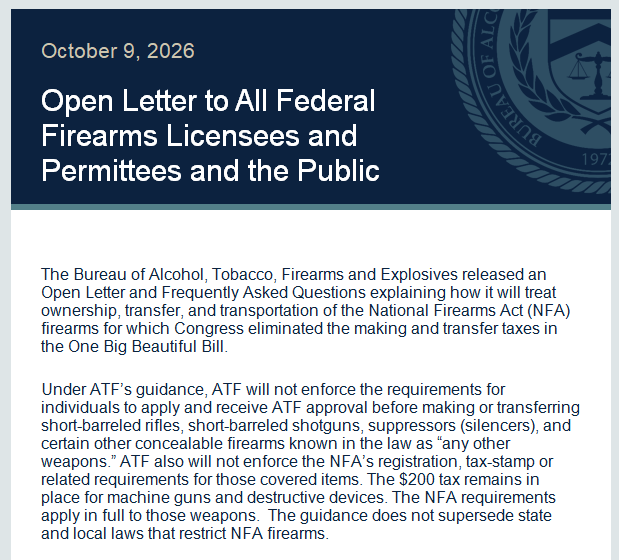
The process for purchasing certain National Firearms Act (NFA) items is changing. On October 9, 2026, the Bureau of Alcohol, Tobacco, Firearms and Explosives (ATF) issued new guidance stating that it will no longer enforce certain federal NFA approval, registration, and tax-stamp requirements for suppressors, short-barreled rifles (SBRs), short-barreled shotguns (SBSs), and certain other weapons classified as Any Other Weapons (AOWs).
This represents a significant change in the federal regulatory process for eligible items. However, federal guidance does not eliminate state firearm laws, dealer transfer requirements, or the need to comply with applicable federal firearm purchasing regulations.
At Proven Arms & Outfitters, we want our customers to understand what these changes mean, how they may affect purchases in their state, and what to expect when ordering NFA-regulated products.
1. What Does the New ATF Guidance Mean for the General Public?
Under the October 9 guidance, the ATF will no longer enforce certain federal NFA requirements for the covered items listed above. This means eligible buyers may no longer need to complete the traditional federal NFA approval and registration process before taking possession of a covered item, depending on the applicable circumstances and state law.
For many customers, this could mean a simpler purchasing experience and fewer federal administrative steps.
What customers should know
- Suppressors: The traditional federal NFA approval and registration process is no longer being enforced by the ATF under this guidance.
- Short-barreled rifles (SBRs) and short-barreled shotguns (SBSs): These items are also covered by the new federal non-enforcement policy, although other applicable firearm laws and transfer restrictions remain relevant.
- Any Other Weapons (AOWs): Certain firearms falling within this federal classification are included.
- Standard firearm purchasing requirements remain: Eligible transactions through a federally licensed firearms dealer still require applicable paperwork, including ATF Form 4473, and a NICS background check unless an exemption applies.
- State and local laws remain in effect: A state may continue to prohibit particular items or require additional documentation, registration, or other procedures.
Important distinction: This is an ATF non-enforcement policy for specified federal NFA provisions. It should not be interpreted as the elimination of every NFA-related law or as a guarantee that every covered item can be purchased without additional requirements.
Machine guns and destructive devices remain subject to the applicable NFA requirements, including the federal tax and registration provisions.
Official guidance: https://www.atf.gov/firearms/update-to-nfa-transfer-guidance
2. States Where the Purchasing Process May Be Simpler
Customers in states that do not independently impose additional NFA registration or transfer requirements may experience a more straightforward purchasing process for eligible suppressors and other covered items.
The following 27 states are identified in the supplied state classification as “Open States,” where the traditional state-level NFA process is generally not required for eligible purchases:
Alabama, Arizona, Arkansas, Florida, Idaho, Indiana, Iowa, Kansas, Kentucky, Louisiana, Maine, Maryland, Minnesota, Missouri, Nebraska, New Hampshire, New Mexico, Oklahoma, South Carolina, South Dakota, Tennessee, Texas, Utah, Vermont, Virginia, West Virginia, and Wyoming.
For eligible transactions in these states, customers may be able to complete the purchase through a participating firearms dealer using the standard federal firearm transaction process, without the traditional ATF Form 4 approval and registration process.
However, the exact procedure depends on the item being purchased, the customer's eligibility, the receiving dealer's policies, and current federal, state, and local law.
Being in an “Open State” does not automatically make every NFA item legal or eliminate every transfer requirement. Customers should confirm the requirements for their particular item and location before placing an order.
3. States With Additional NFA-Related Requirements
Some states maintain their own restrictions, registration provisions, or other requirements that can affect the purchase and possession of suppressors and other NFA-related items, even under the new federal guidance.
The following 15 states are identified in the supplied classification as states where customers may encounter additional state-specific NFA procedures:
Alaska, Colorado, Connecticut, Georgia, Michigan, Mississippi, Montana, Nevada, North Carolina, North Dakota, Ohio, Oregon, Pennsylvania, Washington, and Wisconsin.
In these states, customers should not assume that the federal change automatically removes state-level obligations. Depending on the state and item, additional paperwork, registration, dealer procedures, or other legal requirements may continue to apply.
The traditional Form 4 process may still be used where appropriate, including when necessary to address state-specific requirements. However, the ATF's new federal non-enforcement policy means that a Form 4 should not be described as universally required under federal law for every covered item.
North Carolina customers: Before purchasing a suppressor, SBR, SBS, or other covered item, verify the current requirements with a knowledgeable local firearms dealer and review the applicable state and federal rules.
4. States and Jurisdictions Where Suppressors Are Prohibited
The supplied classification identifies the following eight states and Washington, D.C., as jurisdictions where civilian suppressor possession is generally prohibited or significantly restricted:
- California
- Delaware
- Hawaii
- Illinois
- Massachusetts
- New Jersey
- New York
- Rhode Island
- Washington, D.C.
Customers in these jurisdictions should not assume that the federal ATF guidance overrides a state or local prohibition.
Firearm laws can differ by item type, permitted use, exemptions, and individual circumstances. Customers should confirm the current legal status of the specific item before attempting to purchase, ship, or possess it.